|
Good to know: some administration information
In general
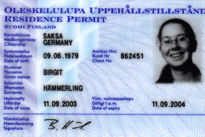
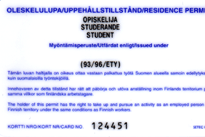
Each citizen of the European Union is entitled to stay in another European Union state up to three months. For all stays, which last longer, s/he has to apply for a permission. In Finland, you can apply for such a permission at the police station of your city. The permission is called "residence permit" or in Finnish "Oleskelulupa". The condition to receive this permission is the proof of a conclusive reason for your long stay, e.g. a work contract or - in the case of studying abroad - a confirmation letter of the guest university. You have to apply for the permission within the first 14 days of your stay and it costs approximately 27 euro (two passport pictures are needed). To your information: the duration of the stay is not interrupted by home travels.
Important is also a local health insurance: :
In general, your health insurance is covered by your home insurance. Therefore, you only have to show that you are insured in your home country (forms E-111 and E-128, which is the proof of the insurance). It is however the case that if you go to a doctor you have to pay immediately the bill. The bills (also for medicines) can be given afterwards to the local agency of the Finnish institute for social security in order to get back the money (60% of the doctor's expenses and 50% with medicines). If you leave the country earlier, so you can't go there, you can give the bills to your home insurance institute.
However, a private foreign health insurance is recommended. Depending on offer, the bills are paid directly. For foreign stays up to one year the Finnish enterprise Pohjola Insurances offers over its subsidiary company Eurooppalainen a special insurance. It addresses to exchange students, trainees etc. such an insurance as well as a luggage insurance for their stay in Finland. This offer is done in co-operation with the CIMO (Centre for internationally Mobility). As I noticed, the stated prices are much cheaper in relation to German offers. You can find further information at http://www.eurooppalainen.com.
"Daily Life"-expenditures
Let's come to the most interesting point - how expensive is living in Finland ??
In relation to Germany, food is approximately 10 to 20 per cent more expensive; but you can also find some products that are cheaper than at home (of course, it depends on your home town - in my case - Kiel - I hardly notice a difference... =) ). Intesting to me is, that the most expensive products are products made from paper (e.g. a simple postcard costs at least 80 cents). That may be because of the Finnish attention for nature...
Concerning the rent of the student houses, there are differences (in Salo):
Some of my colleagues pay about 230 euro for a room in a 2 person flat, which is situated not far from the city centre, from the university is however far distant (approx. 45 min by foot). I live together with five girls in a student appartment next to the polytechnic. Here I've got a small, but cosy room, for which I pay about 100 euro per month. That is however probably rather an exception of the rule - the rent is usually approximately 200 euro per month. The international coordinator of the polytechnic will help you to find a suitable accommodation for your stay - just ask! In Salo, the polytechnic has got even its store for housing equipment, so that every exchange student can rent a so-called starter package for 50 euro (security) bail (e.g. mattresses, table-ware, lamps).
As a student, "travelling around" is relatively favorable in Finland - in relation to German train fees almost mockery-cheap... =). For a trip from Helsinki to Rouvaniemi in Lappland (approx. 900 km), you have to pay approximately 35 euro as a student (one trip). To get these prices, you need a special document of identification that must be signed by your university or polytechnic. (This document can be found on the web page of the Finnish train company: http://www.vr.fi). You can apply then for a student pass for the trains (price: 2 euros). It is also possible to get a student pass for the long distance busses (price: 5,40 euros, for each pass a photo is needed). These acquisitions pay in any case - usually already with the first trip.
|
|