|
The Finnish education system
Recently, the Finnish education system has become world wide attention - Finnish pupils are some of the "winners" of the PISA study. Some German education politicians and specialists already traveled to Finland - it is spoken already of a "PISA tourism" - in order to check whether and to which extent elements of the Finnish education system can be transferred. Therefore, I added also a short introduction to the Finnish education system to my website.
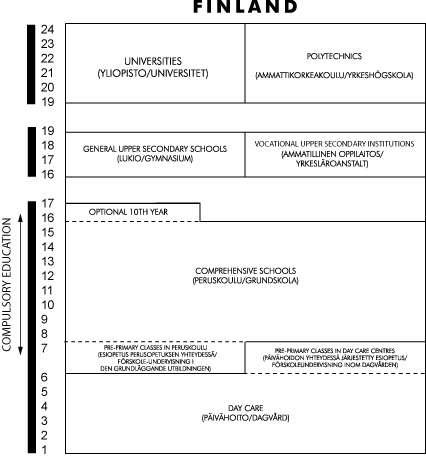
Similarly to Germany, compulsory schooling exists in Finland (here: up to the age of 16 years). The "school time" starts with the age of seven years, in addition a preparatory school can be attended for one year. All pupils visit a kind of comprehensive school (the lower level in the education system). When the comprehensive school is completed the compulsory schooling is fulfilled. The pupils can enter then either directly into the working life or can visit schools of the central stage of the education system. Here they have the choice between a general school (comparable with the German Abitur) and a kind of vocational school (more instruction, less practice in comparison to Germany). Finally, the Finnish pupils can attend the higher education schools: universities and polytechnics. The polytechnics are quite new: they were founded in the 90's. The polytichnic system can be compared with the German system of "Fachhochschulen", meaning that the training offer is rather oriented at practice as at the universities. In the field of higher education, there are a few differences to Germany, however the study times are not shorter than in Germany on the average (example: studying at a polytechnic: 3.5 years - German Fachhochschule: 4 years).
A central goal of the Finnish basic education (lower level) is - above all - to ensure the development of the pupils to humanly and ethicalally responsible members of the society. Beyond that, it is to be guaranteed that they are equipped with the necessary knowledge and abilities for their later life. Important is also to take care of the education quality is in the whole country, i.e. no (locally caused) deviations in the education may arise.
|
|